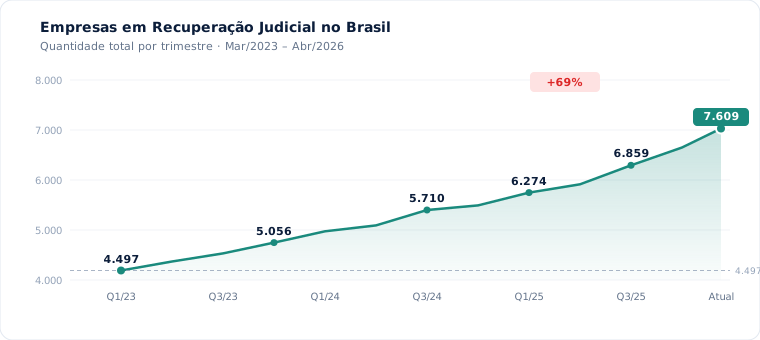
Brazil closed 2025 with 5,680 companies in judicial reorganization (recuperação judicial, Brazil's court-supervised restructuring, similar to Chapter 11) — a record, according to the RGF Monitor, which excludes micro-businesses from its count. Analyzing the national CNPJ registry maintained by the Receita Federal (Brazil's federal tax authority), which covers companies of every size, the universe is even larger: more than 7,200 records at the end of 2025 and around 7,600 in April 2026.
FonteData has processed quarterly snapshots of the open CNPJ dataset (a CNPJ is the Brazilian company registration number) since March 2023, identifying every company whose legal name contains "EM RECUPERAÇÃO JUDICIAL". We cross-referenced this data with the federal debt registry of the PGFN (Brazil's attorney general's office for the national treasury) and the financing operations of the BNDES (Brazil's national development bank) to reveal not just how many these companies are, but who they are, where they operate, in which sectors, and how they relate to public money.
2025 broke the all-time record
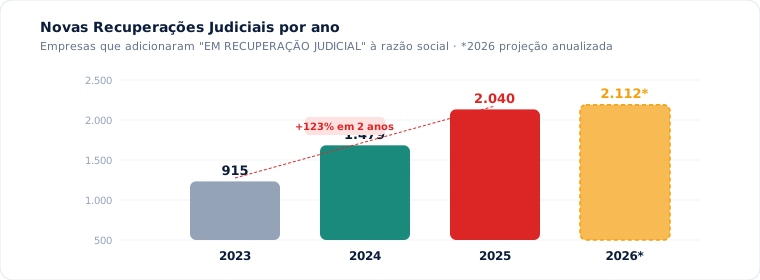
The pace of new judicial reorganizations more than doubled in three years. In 2023, 915 companies added the reorganization flag to their Receita Federal record. In 2024, the number jumped to 1,479. And 2025 sealed the record: 2,040 new companies entered judicial reorganization over the year — up 123% from 2023.
The first quarter of 2026 already projects an annualized pace of 2,112, above any quarter of the previous two years.
The acceleration is especially visible from the second half of 2024 onward. In the third quarter of that year, 493 new companies entered reorganization — 60% above the average of the preceding quarters. And the first quarter of 2025 marked the peak of the series: 638 new reorganizations at once.
The drivers of this acceleration are well known: prolonged high interest rates (the Selic benchmark rate reached 15%), tight credit for smaller companies, lingering pandemic-era debt and, in agribusiness, the combination of falling commodity prices and adverse weather events. The 2020 reform of Brazil's bankruptcy law, which broadened access to the instrument, also contributed to the increase — especially among rural producers and small business owners.
The crisis migrated from big companies to small ones
The most revealing finding in the historical series isn't the total, but the composition. Breaking companies down by registered capital bracket, the pattern is unmistakable: the smaller the company, the faster reorganizations are growing.
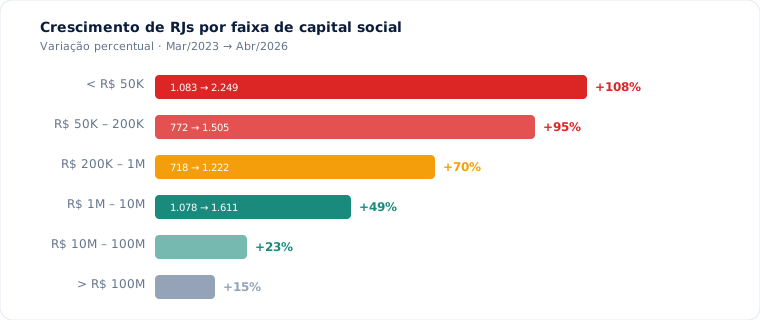
Companies with registered capital below R$ 50,000 more than doubled: from 1,083 in March 2023 to 2,249 today — a 108% increase. In the R$ 50,000 to R$ 200,000 bracket, the increase was 95%. Among large companies, with capital above R$ 100 million, growth was just 15%.
The pattern holds when we look at official company size classifications. Micro-businesses and small businesses (EPPs) totaled 1,037 reorganization records at the start of the series (23% of the total). Today they are 2,613 — 34% of the total, with cumulative growth of 152%. Not coincidentally, Serasa Experian found that micro and small businesses accounted for 74% of all judicial reorganization filings in 2024.
| Size | Mar/2023 | Apr/2026 | Growth |
|---|---|---|---|
| Micro-business | 513 | 1,457 | +184% |
| Small business (EPP) | 524 | 1,156 | +121% |
| Others (mid-size and large) | 3,460 | 4,996 | +44% |
Judicial reorganization is no longer an instrument exclusive to large corporations and their law firms. For the small business owner, it has become a survival tool — a signal both of how severe the credit crunch is and of the legal ecosystem's growing familiarity with the process. As the business daily Valor Econômico observed, the 2020 reform brought greater legal certainty, and companies began turning to the remedy with less stigma.
The hardest-hit sectors
Cross-referencing the reorganization data with the CNAE classification (Brazil's business activity classification) of the head-office establishment (filtered to registered capital ≥ R$ 100,000 to exclude token-capital CNPJs), the sector profile holds surprises.
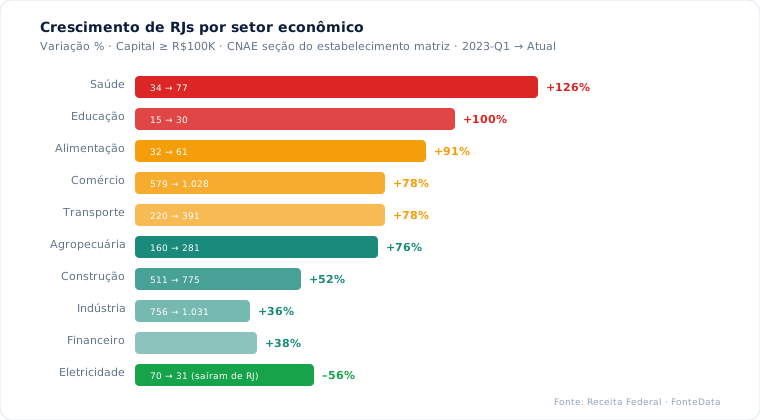
Healthcare leads percentage growth at +126%, from a small base (34 to 77 companies). The crisis among health plan operators and mid-size hospitals — aggravated by post-pandemic costs and mounting litigation over health plans — shows up in the data. The rise of home care companies and consolidation in the sector left many mid-size players squeezed.
Education doubled (15 to 30), highlighted by the 2025 entry of FMU — Faculdades Metropolitanas Unidas (registered capital of R$ 1.6 billion) — a reflection of the exhaustion of the rapid-expansion model financed by FIES (the federal student loan program) and of excess capacity in private higher education.
In absolute volume, Commerce and Manufacturing concentrate most cases — together they represent 44% of all reorganizations with meaningful capital. The RGF Monitor confirms manufacturing's lead, noting the predominance of agribusiness-linked companies such as sugar and ethanol mills, dairies, and meatpackers.
The only sector that shrank was Electricity (–56%), thanks to the conclusion of proceedings involving large special-purpose entities in the energy sector — notably several subsidiaries of Novonor (formerly Odebrecht) and Renova Energia.
The agribusiness question
With 1,145 companies with agricultural activity codes in reorganization and R$ 5.7 billion in aggregate registered capital, agribusiness is a chapter of its own. The sector's cumulative growth of 76% over the period is close to the overall average — but with a marked acceleration over the past twelve months: between the fourth quarter of 2024 and the current data, agribusiness reorganizations grew 41%, roughly double the overall growth in the same period.
Serasa Experian's data corroborates the trend: in 2024, agribusiness recorded 1,272 judicial reorganization filings, more than double the 534 counted in 2023.
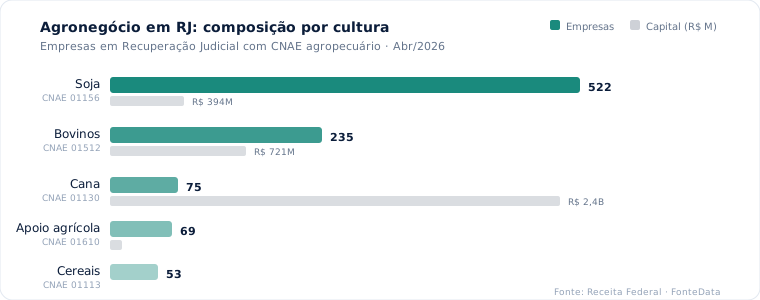
Soy is the epicenter of the crisis: 522 producers in judicial reorganization, nearly half of all agribusiness cases. The president of Aprosoja Brasil, Maurício Buffon, summed up the problem in a statement to Valor Econômico: high production costs, lower commodity prices, bank interest rates reaching 15%–20%, and tight credit form the combination that has been pushing producers to extreme measures.
Next come cattle ranchers (235 companies, R$ 721 million in capital) and sugarcane mills (75 companies, but with R$ 2.4 billion in capital — large-scale operations with liabilities to match).
The geographic distribution confirms the pattern: Goiás (48), Mato Grosso (39), São Paulo (37), and Minas Gerais (36) concentrate most cases — the states of Brazil's central soy and extensive-ranching belt.
A phenomenon still incipient but noteworthy: 34 individual rural producers (legal nature code 4120) are already in judicial reorganization. That number was 1 in March 2023 and jumped by 15 in a single quarter, between the first and second quarters of 2025. It is a direct effect of the bankruptcy law reform (Lei 14.112/2020), which expressly brought individual rural producers within the instrument's reach — and which triggered a public clash between Banco do Brasil and the Brazilian Bar Association (OAB) over the legitimacy of law firms encouraging filings.
The public tab
Cross-referencing the CNPJs in reorganization with the PGFN's federal debt registry and BNDES operations — both from the federal government's transparency portal — adds a fiscal dimension to these companies' profile.
Federal tax debt
Two in every three companies in reorganization (67%) have entries in the federal debt registry:
| Debt type | Companies | Entries |
|---|---|---|
| General debt | 5,113 | 482,543 |
| Social security | 3,067 | 54,653 |
| FGTS | 1,488 | 6,234 |
The largest individual debtors include Companhia de Alimentos Glória, CBE — Companhia Brasileira de Equipamento, Bombril, and Oi. Many of these entries carry decades of accumulated interest and penalties, which can distort nominal values — but the volume of entries per company points to a pattern of structural tax delinquency predating the reorganization filing.
BNDES financing
1,766 companies currently in judicial reorganization received BNDES financing, totaling R$ 42.8 billion in disbursed credit. That is nearly one in four (23%).
| Type | Companies | Operations | Disbursed |
|---|---|---|---|
| Non-automatic (direct) | 65 | 521 | R$ 27.7 billion |
| Automatic (via banks) | 1,701 | 32,314 | R$ 15.1 billion |
The Oi group leads by a wide margin: combining Oi S.A. and Oi Móvel, it received R$ 12.6 billion in BNDES credit. Americanas received R$ 2.7 billion. Estaleiro Atlântico Sul, R$ 2.0 billion.
None of this implies wrongdoing — public financing is a legitimate industrial policy instrument, and many of these operations were contracted years or decades before the crisis. But the volume of public credit concentrated in companies that ended up in reorganization is a relevant indicator both for credit risk assessment and for the debate over the effectiveness of development policies.
States under pressure
The crisis is not evenly spread across the country. Some states saw growth far above the national average.
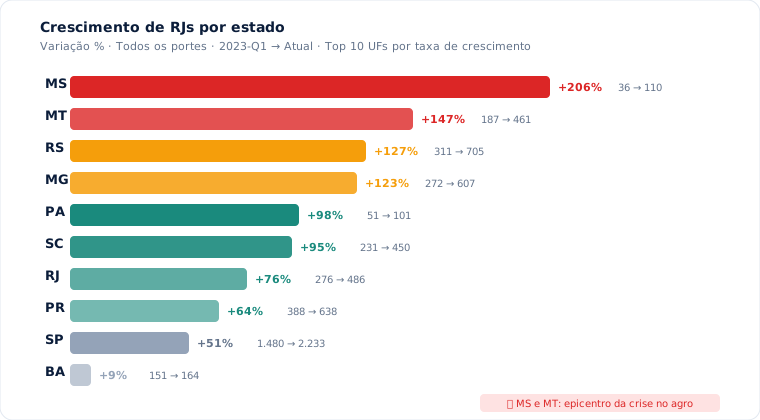
Mato Grosso do Sul (+206%) and Mato Grosso (+147%) lead by a wide margin — a direct reflection of the agribusiness crisis. The RGF Monitor confirms it: MS had the largest increase in companies in reorganization of any Brazilian state in 2025.
Rio Grande do Sul (+127%) combines the agribusiness impact with the aftermath of the May 2024 floods, which devastated the productive infrastructure of thousands of companies. The state closed 2025 with 507 companies in reorganization according to Valor Econômico — 705 in the broader count that includes micro-businesses.
Minas Gerais (+123%) surprises with the magnitude of its growth, reflecting the state's exposure both to agribusiness (coffee, cattle) and to manufacturing and mining.
São Paulo still concentrates 29% of the absolute total, but is growing below the national average (51%).
The good news: those who exit, recover
Analyzing the companies that shed the reorganization flag between late 2025 and early 2026, the results are encouraging. Our survey identified 102 exits in the period, and we checked the current registration status of each one:
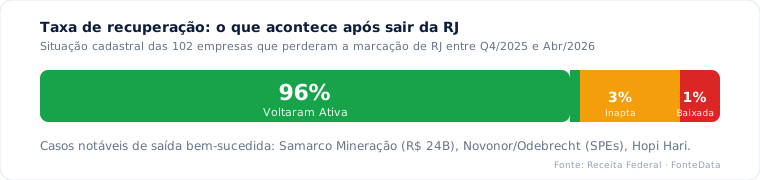
96% returned to "Active" status — they completed their recovery plans successfully and are operating normally. Only 3% became inapt and 1% were closed. Notable successful exits include Samarco Mineração (R$ 24 billion in capital), several Novonor/Odebrecht special-purpose entities, and the Hopi Hari theme park.
This finding is consistent with the survey by RGF & Associados, which reported that 80% of companies exiting reorganization in the first quarter of 2025 resumed operating without court supervision. Judicial reorganization, when completed, works. The growing challenge is the volume of companies that need it.
What to expect
The data points to a continuation of the growth trend. The annualized pace of new reorganization filings shows no sign of slowing — on the contrary, the last four quarters were the most intense of the entire series.
Three dynamics should stay on the radar:
Micro and small businesses will remain the fastest-growing segment. The democratization of access to judicial reorganization is a structural trend, not a cyclical one, and the high Selic rate disproportionately squeezes those who depend on working capital.
Agribusiness will hinge on the 2025/2026 harvest and a recovery in soy prices. If fundamentals don't improve, the flow of new filings should keep accelerating — especially among mid-size producers in the Center-West. As the president of Aprosoja warned: "the crisis will be much worse this year".
Individuals in judicial reorganization are the newest and least-studied phenomenon. From 1 to 34 records in three years may seem small, but the curve is exponential and the legal framework, since Lei 14.112/2020, keeps evolving to accommodate this demand.
FonteData will track the evolution of this data quarterly. The data used in this analysis is available through our public data API.
Methodology · Source: open CNPJ data from Brazil's Receita Federal. Criterion: companies whose legal name contains "EM RECUPERAÇÃO JUDICIAL" in the Companies table. Cross-validation with the situacao_especial field of the Establishments table indicates ~98% coverage. Quarterly snapshots from Mar/2023 to Dec/2025, plus the current dataset as of Apr/2026. Sector analysis uses the primary fiscal CNAE of the head-office establishment, filtered to capital ≥ R$100K. Cross-referencing with PGFN and BNDES via the federal transparency portal. The FonteData count includes companies of all sizes, differing from the RGF Monitor (which excludes micro-businesses and branches) and from Serasa Experian (which counts court filings). Growth trends are convergent across the three sources.
Try the FonteData API
Query Brazilian company and individual data via API — CNPJ, CPF, KYC, compliance and more. R$50 in free credits to test.
Create free account →