TL;DR: Registration status (situação cadastral) is the status the Receita Federal (Brazil's federal tax authority) assigns to a CNPJ (Brazilian company registration number) or CPF (Brazilian individual taxpayer ID) to indicate whether the document is in good standing or restricted. A CNPJ has five statuses (active, suspended, inapt, closed, and null); a CPF has six (regular, pending regularization, suspended, cancelled, deceased holder, and null). Checking this status is the first step of any due diligence — before signing a contract, extending credit, issuing an invoice, or opening a business account.
Registration status is the status the Receita Federal assigns to a CNPJ or CPF to indicate whether the document is in good standing or subject to some restriction. A CNPJ has five possible statuses — active (ativa), suspended (suspensa), inapt (inapta), closed (baixada), and null (nula). A CPF has six — regular, pending regularization (pendente de regularização), suspended (suspensa), cancelled (cancelada), deceased holder (titular falecido), and null (nula). Checking this status is the first step of any due diligence: before signing a contract, extending credit, issuing an invoice, or opening a business account.
This guide explains what each status means, the practical consequences of each, and the path to regularization, based on the Receita Federal rules currently in force.
What is registration status?
Registration status is the state of a record — CNPJ or CPF — in the registry maintained by the Receita Federal. It answers an objective question: is this document fit to be used in commercial and financial transactions?
One point that causes confusion: registration status is not the same as tax standing. Registration status concerns the regularity of the record (correct data, filings submitted, valid registration). Tax standing concerns debts. A company or individual can owe taxes and still keep their registration listed as "active" or "regular". These are complementary checks — one does not replace the other.
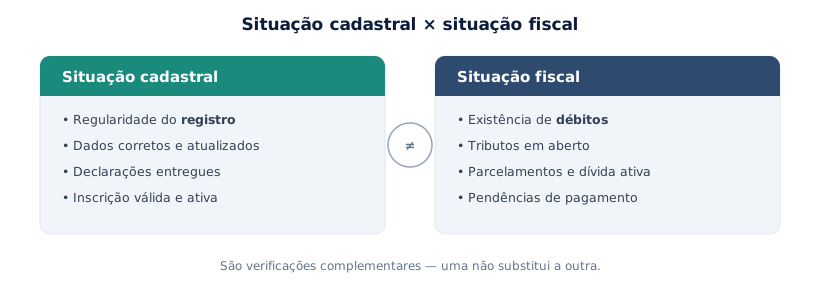
CNPJ registration status is defined by Article 39 of Instrução Normativa RFB nº 2.119/2022 (a Receita Federal regulation). CPF status is defined by Instrução Normativa RFB nº 2.172/2024.
CNPJ registration status: the 5 statuses
The practical reading is straightforward: active is the goal; suspended and inapt are recoverable problems; closed and null are, in the overwhelming majority of cases, permanent.
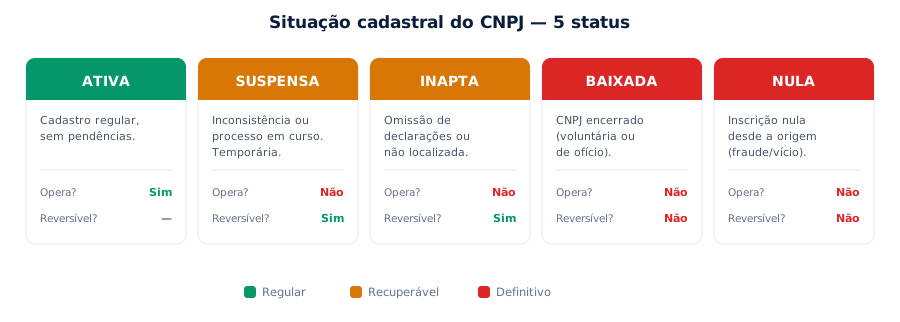
| Status | What it means | Can the company operate? | Reversible? |
|---|---|---|---|
| Active (ativa) | Record in good standing, no pending issues | Yes | — |
| Suspended (suspensa) | Temporary condition due to an inconsistency or a process in progress | Not until regularized | Yes |
| Inapt (inapta) | Missing filings or company not found at its address | No | Yes |
| Closed (baixada) | CNPJ terminated (voluntarily or by the authority) | No | Generally not |
| Null (nula) | Registration declared void from inception | No | No |
Beyond the status itself, the official registration certificate (Comprovante de Inscrição e de Situação Cadastral) includes a "Reason for Registration Status" field, which details the specific cause — for example, missing filings, temporary interruption, merger, or liquidation. That field is what tells you exactly what needs to be fixed.
Active (ativa)
The record is in good standing with the Receita Federal, with no events placing the company in any of the other statuses. It is the normal condition of a company that operates and keeps its obligations current. It is usually a prerequisite for opening a business bank account, obtaining credit, bidding on public contracts, and issuing invoices. Keep in mind: an active CNPJ confirms that the company exists and is fit to operate, but it does not guarantee the absence of debts, lawsuits, or protests — those require complementary checks.
Suspended (suspensa)
A temporary status. It can result from a closure request in progress (while not yet approved), a court order, inconsistent registration data, signs of fraud, or a temporary interruption of activities reported to the registry authority. While suspended, the company is barred from operating normally and from issuing tax documents. In most cases, it is resolved within a few days after the corresponding registration fix, and the status returns to "active".
Inapt (inapta)
As a rule, inapt status results from failing to submit required filings for two consecutive fiscal years (mandated by Article 81 of Lei nº 9.430/1996). It can also result from a nonexistent address — when the company cannot be located. The consequences are severe:
- Inclusion in Cadin, the federal registry of unpaid public-sector credits;
- Restrictions on transacting with banks, moving funds, and obtaining loans;
- Tax documents issued during the period are deemed invalid (inidôneos), which also affects whoever received those invoices (loss of tax credits).
Inapt status is reversible: the path is to gather the missing filings, submit them through the e-CAC portal, and track the update. The catch is the deadline — a registration that stays inapt for 180 days without regularization can be closed by the Receita Federal on its own initiative.
Closed (baixada)
Indicates the CNPJ has been terminated. This can happen at the holder's request (voluntary closure) or by determination of the Receita Federal (closure by the authority, common after prolonged inapt status). Closure means loss of legal personality: the company can no longer issue invoices, hold accounts, or operate. Closure does not erase prior debts — outstanding liabilities can still be pursued against the responsible parties. When activity is to resume, the practical route is usually to open a new registration, always with an accountant's guidance.
Null (nula)
The rarest and most serious case. The registration is declared void from inception, usually because a defect, fraud, or duplication was identified in the formation process. The company's entire fiscal existence is invalidated retroactively, and the CNPJ can be neither reactivated nor reused.
CPF registration status: the 6 statuses
The CPF follows a similar logic, with six statuses defined by Instrução Normativa RFB nº 2.172/2024. Important: CPF regularity does not depend on paying taxes — having debts does not, by itself, make the registration irregular.
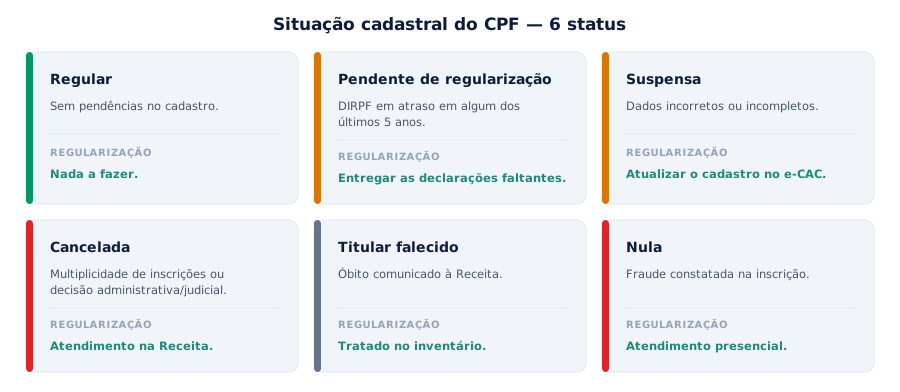
| Status | What it means | Path to regularization |
|---|---|---|
| Regular | No pending issues on the record | Nothing to do |
| Pending regularization (pendente de regularização) | Income tax return (DIRPF) missing for one of the last 5 years | Submit the missing returns |
| Suspended (suspensa) | Incorrect or incomplete data | Update the record via e-CAC |
| Cancelled (cancelada) | Duplicate registrations or an administrative/court decision | In-person service at the Receita Federal |
| Deceased holder (titular falecido) | Death officially reported | Handled in probate |
| Null (nula) | Fraud found in the registration | In-person service |
Regular
No pending issues or inconsistencies. This is the ideal condition for any financial or commercial transaction — credit, account opening, financing. Assigned only to living holders.
Pending regularization (pendente de regularização)
The most common of the irregular statuses. It generally means the taxpayer failed to file their income tax return (DIRPF) in at least one of the last five years. Even someone who is exempt can fall into this status if the Receita Federal detects financial activity inconsistent with an exemption. The fix is to submit the overdue returns, even if filed as exempt.
Suspended (suspensa)
Indicates an incorrect or incomplete record — name, date of birth, or diverging data. A frequent cause is a mismatch with the Electoral Court records, since the Receita Federal cross-checks that information. It is resolved by updating the registration.
Cancelled (cancelada)
The CPF loses validity for transactions. It happens due to multiple registrations (the person holds more than one CPF) or an administrative or court decision. Reactivation requires a specific process at the Receita Federal.
Deceased holder (titular falecido)
A security update applied when the Receita Federal receives official notice of the holder's death, usually from a registry office. It closes the record permanently — the CPF is neither transferred nor reused, and estate matters proceed through probate.
Null (nula)
Indicates fraud at the origin of the registration. The number is considered invalid from creation and cannot be recovered.
Why check registration status before doing business
Checking registration status is one of the cheapest ways to avoid losses. Scenarios where the check is strongly recommended include:
- Customer and supplier onboarding — confirming that the counterparty exists and is fit to operate;
- Credit granting and account opening — regularity is a basic indicator of a healthy record;
- Issuing and receiving invoices — an invoice issued by an inapt or closed CNPJ is invalid and can cost the recipient ICMS, PIS, and COFINS tax credits;
- Public procurement qualification — regular status is usually a formal requirement;
- Fraud prevention — closed or inapt CNPJs and null CPFs are frequently used to issue fake documents.
One important note on scams: the Receita Federal does not cancel a CPF over bank debt or a negative credit record. Messages claiming "CPF cancelled due to debt" are, as a rule, fraud attempts.
How to check registration status
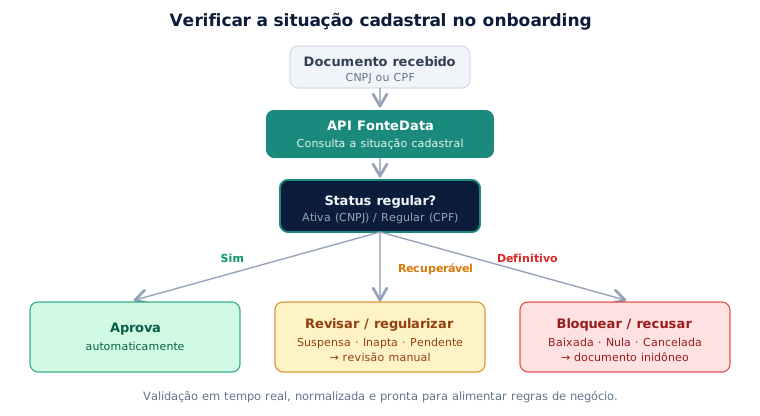
For a one-off check, the lookup is free and public on the Receita Federal website. For a CNPJ, the 14 digits are enough. For a CPF, you need the number and the holder's date of birth — there is no lawful way to discover a CPF from a name, as it is personal data protected by the LGPD (Brazil's data protection law).
When the need is to validate at scale or embed the check into your own system — in onboarding, fraud prevention, credit analysis, or compliance flows — manual lookups don't hold up. In that scenario, the way forward is an API: registration status is returned in a normalized format, in real time, ready to feed business rules automatically. That is exactly what FonteData delivers — access to official registry data through a single REST API, with the compliance that handling this kind of data demands.
We cover the automation step by step in our guides on CNPJ lookup via API and CPF lookup via API.
Frequently asked questions
What is the difference between registration status and tax standing? Registration status indicates the regularity of the record (data, filings, validity of the registration). Tax standing indicates the existence of debts. It is possible to have a regular registration and still owe taxes.
Are suspended and inapt CNPJs the same thing? No. Suspended usually indicates a registration inconsistency or a process in progress, typically recoverable in a few days. Inapt is more serious: it stems from two consecutive years of missing filings and opens the door to closure by the authority.
Can a closed CNPJ become active again? As a rule, no. Closure formally terminates the CNPJ. There are specific reversal scenarios when the closure was requested by the holder, but when it is decreed by the authority, the path is administrative and complex. In practice, opening a new registration is usually simpler.
Does the Receita Federal cancel a CPF over debt? No. CPF regularity is not conditioned on paying taxes. Collection messages threatening to "cancel your CPF over debt" are typically scams.
Can I check another person's or company's status? CNPJ registration status is public. CPF status can be checked as long as you have the number and the holder's date of birth — the Receita Federal does not require it to be your own.
What is the "Reason for Registration Status"? It is the field on the certificate that details the cause of the status — for example, missing filings, temporary interruption, or liquidation. It is what tells you what needs to be fixed.
Read next
- CNPJ Lookup API for Brazil: the complete guide
- CPF Lookup via API: how to automate validations
- Alphanumeric CNPJ 2026: timeline, new format, and how to adapt your system
- New Pix rules for 2026: CPF and CNPJ validation
Next step
If your operation needs to verify CNPJ or CPF registration status at scale — for onboarding, fraud prevention, credit analysis, invoicing, or compliance — the most efficient path is API integration. Registration status arrives normalized, in real time, ready to feed your business rules.
FonteData offers official registry data lookups as part of a hub with more than 100 data sources — CPF, CNPJ, KYC, Receita Federal, fraud prevention, and compliance, in the same integration with the same key. You pay per query, with no monthly fee, and get R$50 in free credits to start.
Try the FonteData API Create a free account →
Want to see the endpoints with parameters and sample responses? Go to the documentation →
This article is provided for informational and educational purposes only. It does not constitute legal advice, a legal opinion, or a regulatory recommendation. For regularizing a specific case, consult an accountant or a qualified professional.
References
- Receita Federal — CNPJ Lookup (Registration and Status Certificate)
- Receita Federal — CPF Registration Status Lookup
- Instrução Normativa RFB nº 2.119/2022 — National Registry of Legal Entities (CNPJ)
- Instrução Normativa RFB nº 2.172/2024 — Individual Taxpayer Registry (CPF)
- Lei nº 9.430/1996, art. 81 — inapt status for missing filings
Try the FonteData API
Query Brazilian company and individual data via API — CNPJ, CPF, KYC, compliance and more. R$50 in free credits to test.
Create free account →