Brazil opened 5.19 million companies in 2025. An all-time record. Headlines celebrate the Brazilian "entrepreneurial spirit". Governments tout the numbers.
But when you look inside the data — not the headlines, but the 274 million records cross-referenced across the Receita Federal (Brazil's federal tax authority), the PGFN (Brazil's attorney general's office for the national treasury), and the BNDES (Brazil's national development bank) — a different story emerges. One that nobody is telling.
The number nobody mentions: 96%
Of all companies opened in Brazil in 2025, 95.8% have zero partners. They are one-person CNPJs (a CNPJ is a Brazilian company registration number).
This isn't new — the trend goes back a long way. But the acceleration is striking:
- 2005: 59% of new companies were solo
- 2010: 81%
- 2015: 90%
- 2020: 95%
- 2026 (through March): 96%
Meanwhile, companies with two or more partners — what we've historically called a "partnership", "starting a business with someone" — fell from 226,000 per year in 2005 to just 54,000 in 2026 (annualized projection). They halved in absolute terms over a period in which total company formation grew 9x.
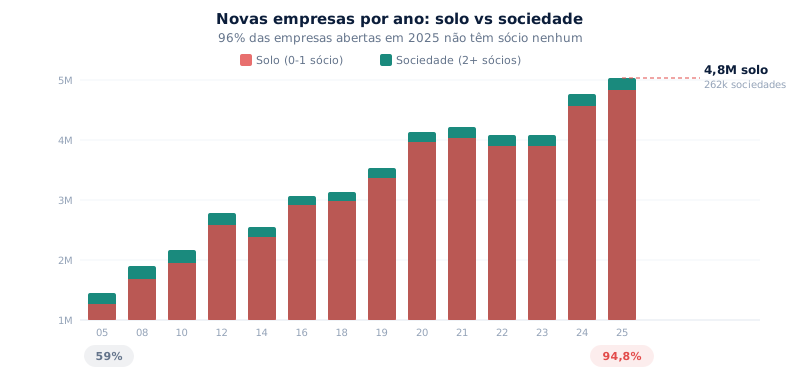
Brazil isn't opening more companies. It's opening more CNPJs. And the difference matters.
Three hypotheses for the same data
The numbers alone don't distinguish cause. What we know is the effect: millions of Brazilians trading a formal employment contract (or informal gig work) for a solo CNPJ. But why?
Hypothesis 1: Genuine entrepreneurship
Getting a CNPJ became much easier. The MEI (Microempreendedor Individual, Brazil's simplified sole-proprietor regime), created in 2009, cut the formalization barrier to nearly zero: no red tape, a flat monthly tax, and online registration in minutes. It's plausible that millions of Brazilians who always had a knack for business — the neighborhood hairdresser, the electrician, the home baker — finally formalized.
The data supporting this hypothesis: the fastest-growing sectors include hairdressers (960,000 active), snack bars (486,000), mini-markets (476,000), and auto repair shops (281,000). These are real businesses, with customers at the door.
Hypothesis 2: Precarization of work
The 2017 labor reform, combined with the 2015–2016 recession and the 2020 pandemic shock, created incentives — or necessities — for companies to replace formal employees with contractors. The worker who used to be an employee is now a "service provider" with their own CNPJ.
The data supporting this hypothesis: among active companies opened in recent years, the fastest-growing sectors are "sales promotion" (code for freelance marketing), "passenger transport with driver" (Uber/99), "rapid delivery services" (iFood/Rappi), and "generic administrative support" (contractor secretarial work). These "disguised employment" activity codes (CNAEs — Brazil's business activity classification) accounted for 4% of new active companies in 2010. By 2026, they are 22% — and for the first time have overtaken the activity codes for genuine businesses.
Hypothesis 3: Formalization of the informal economy
Brazil has always had sky-high informality — more than 38 million informal workers. The MEI didn't create new workers — it just gave a CNPJ to people who were already working. The bicycle courier existed before iFood; now he issues invoices.
The data supporting this hypothesis: the growth in company formation tracks the MEI curve almost perfectly. Strip out the MEI, and the number of new "traditional" companies (with partners, capital, and structure) has been essentially flat for the past 15 years.
The truth is most likely that all three hypotheses are correct simultaneously, in proportions that vary by region, sector, and period. What the data proves unequivocally is the outcome: the Brazilian CNPJ of 2026 is radically different from the CNPJ of 2005.
The 2025 crossover
Among active companies opened in recent years, we classified activity codes into two groups: those that serve as a proxy for "disguised contractor" work (app drivers, couriers, freelance marketers, administrative support) and those for genuine businesses (restaurants, clothing stores, auto repair shops, mini-markets).
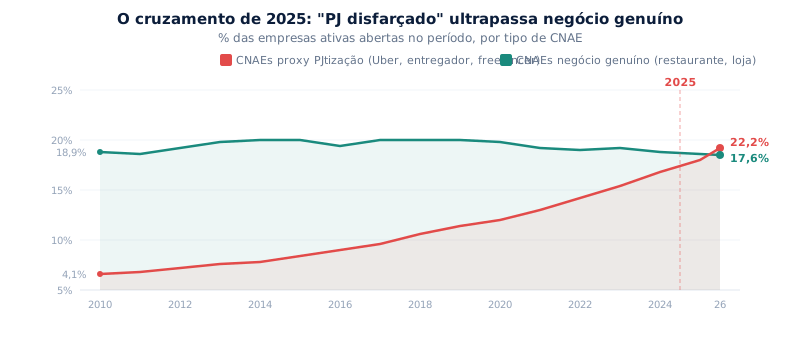
In 2010, the contractor-proxy activity codes made up 4.1% of active companies; genuine-business codes, 18.9%. In 2025, for the first time, the lines crossed: 19.9% vs 17.9%. In 2026, the gap only widens: 22.2% vs 17.6%.
It's important to note that this classification is a proxy — not proof. A marketing consultant can be either a downgraded ex-employee or a legitimate entrepreneur. But the trend is undeniable.
The reality check: who survives?
If the CNPJ boom were mostly genuine entrepreneurship, we would expect reasonable survival rates. That's not what the data shows.
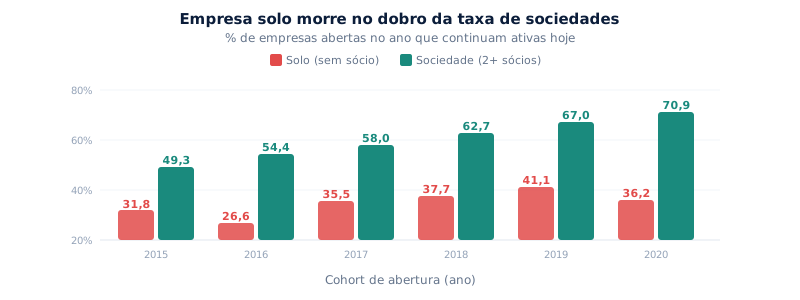
Solo companies die at twice the rate of partnerships. Of the 3.7 million solo companies opened in 2020, only 1.35 million (36%) are still active. Among partnerships, 71% survive.
This suggests that a large share of solo CNPJs are not companies in the economic sense — they are workers who needed a CNPJ temporarily. When the reason goes away (a job comes back, the app changes its rules, the gig ends), the CNPJ dies.
The great CNPJ graveyard
Brazil has 67.2 million registered companies and 70.4 million registered establishments. But most are already dead:
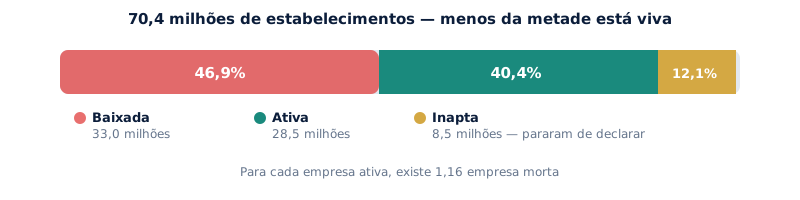
The CNPJ factory runs at full steam. In 2000, Brazil opened 619,000 companies per year. In 2010, 1.5 million. In 2025, it passed 5 million. But of the 4 million opened in 2020, only 1.55 million survive — a 61% mortality rate in 6 years.
The MEI revolution
The MEI is the silent protagonist behind all of these statistics.
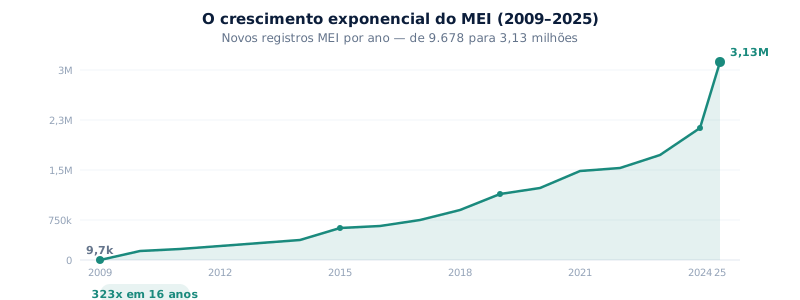
- 2009 (creation): 9,678 registrations
- 2015: 502,000 new per year
- 2020: 1.13 million per year
- 2025: 3.13 million per year — representing 73% of all new entrants into the Simples Nacional (Brazil's simplified tax regime for small businesses)
- Total active today: 16.6 million
The MEI is, by far, the largest labor formalization program in Brazil's history. And like every program of that magnitude, it came with consequences nobody foresaw.
The democratization of debt
This is perhaps the most revealing — and most troubling — finding of the entire analysis.
The PGFN records 24.8 million entries in the general federal debt registry (dívida ativa). In 2018, the "Simples Nacional" revenue category had 658 entries. MEI, zero. Six years later:
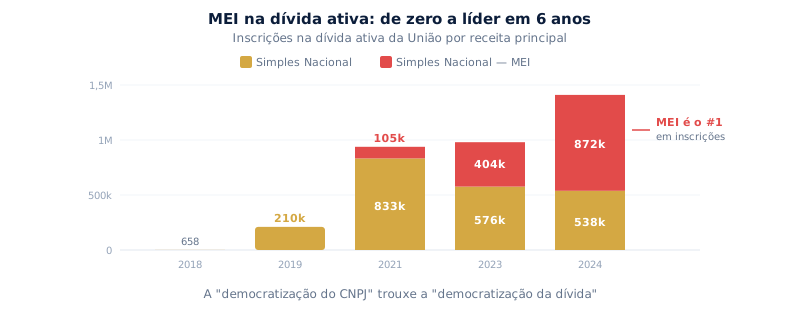
In 2024, Simples Nacional — MEI is the #1 revenue category by number of entries in the federal debt registry, with 872,000 new records. Add regular Simples Nacional and it's 1.4 million entries in a single year.
The debtor profile changed
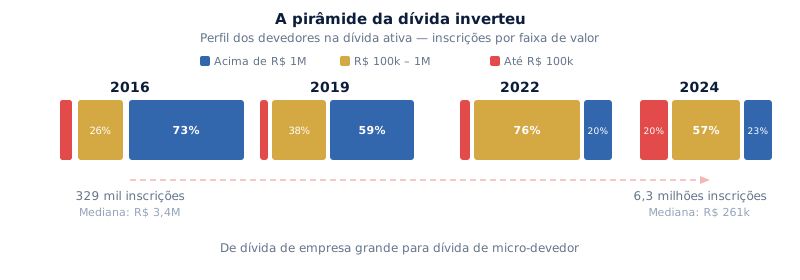
In 2016, 73% of entries were above R$ 1 million. In 2024, 20% are for amounts up to R$ 100,000 — the profile of a delinquent MEI or micro-business. The median debt value fell from R$ 3.4 million (2016) to R$ 261,000 (2024).
The status of these debts
Of the 24.8 million entries, the breakdown is:
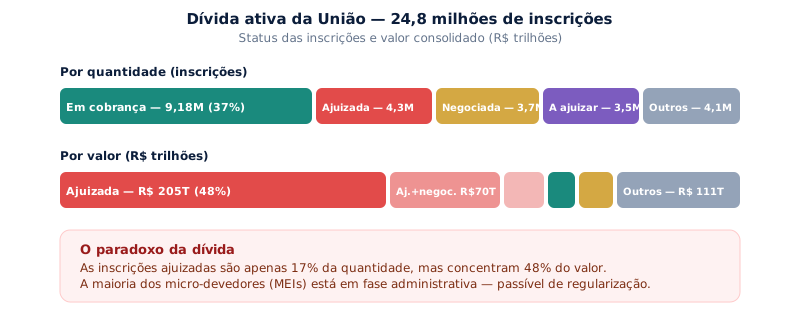
Entries under court enforcement are 17% of the count but concentrate 48% of the value (R$ 205 trillion). Most micro-debtors (MEIs and micro-businesses) are in administrative collection (9.18 million) or negotiated under SISPAR (3.73 million) — eligible for installment plans and regularization.
The "democratization of the CNPJ" brought with it the "democratization of debt". Millions of Brazilians who used to be informal — and therefore invisible to the tax authority — now have a CNPJ, tax obligations, and when they can't pay the R$ 71.60 monthly MEI tax bill (DAS-MEI), they land in the federal debt registry.
The capital paradox
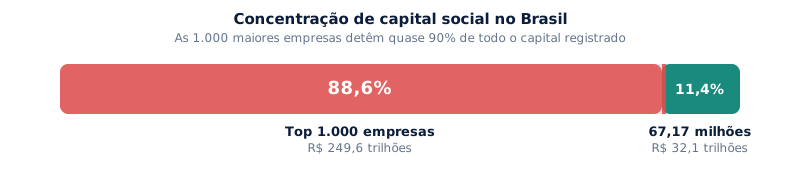
Brazil's 1,000 largest companies hold 88.6% of all registered capital — R$ 249.6 trillion out of a total of R$ 281.7 trillion. The other 67.17 million companies split the remaining 11.4%.
At the base of the pyramid:
- 26% of companies have zero registered capital
- 23% have capital of up to R$ 1,000
- 80% have capital of up to R$ 10,000
Brazil operates in two parallel worlds: a thousand giants with trillion-real capital, and 67 million micro-CNPJs with no financial cushion.
The concentration map
São Paulo concentrates 30.4% of all active companies (8.67 million). The 5 states of the South and Southeast together account for more than 60% of the total.
Mortality rates vary significantly: Rio Grande do Sul leads with 51.3% of CNPJs already closed, while Santa Catarina has the best survival rate (45.1% active) among the large states — reinforcing Santa Catarina's reputation as a healthy entrepreneurial ecosystem.
Who the business owners are
The peak is in the 41–50 age bracket (6.7 million individual partners), but the 21–30 bracket already totals 1.9 million — a direct reflection of young MEIs and the platform economy. There are 27,000 partners aged 0–12 (heirs in family holding companies) and more than 1.1 million over 81.
The composition is fundamentally one of solo owners: 49% of companies with registered partners have a single partner, 42% have 2 partners, and only 0.2% have 11 or more.
What the data doesn't say
Activity codes are a proxy, not proof. Classifying "sales promotion" as disguised contracting is an interpretation. A marketing consultant can be either a downgraded ex-employee or a legitimate entrepreneur.
Debt has a status. Of the 24.8 million entries in the federal debt registry, 86% of the value (R$ 368 trillion) is under court enforcement. But only 23% of entries by count have reached that stage. Most micro-debtors are still in the administrative phase, able to negotiate installments or regularize.
Non-survival ≠ failure. A closed MEI CNPJ can mean the worker landed a formal job — a positive outcome, not a negative one.
What the data does say
Five conclusions supported by the dataset:
1. The Brazilian CNPJ changed in nature. It went from a corporate vehicle to a work document. 96% of new registrations are one-person ventures, with no partners, most with no capital.
2. The MEI is the largest labor formalization program in Brazil's history. 16.6 million active, 73% of new Simples entrants. It changed the structure of the labor market permanently.
3. Formalization brought unforeseen consequences. The MEI went from zero to the top of the federal debt registry in 6 years. The "democratization of the CNPJ" brought the "democratization of debt".
4. Solo companies die at twice the rate of partnerships. 34% survival vs 62%. Most new CNPJs are temporary by nature.
5. Concentration is extreme. 88.6% of capital in the top 1,000. 80% of companies with capital of up to R$ 10,000. The country operates in two parallel worlds.
Brazil's "entrepreneurial boom" is real — but counting 67 million CNPJs as "67 million companies" is like counting 67 million CPFs (a CPF is the Brazilian individual taxpayer ID) and claiming we have 67 million formally employed workers. The CNPJ has become the new work permit. And that is a transformation that deserves to be debated with data, not celebrations.
Methodology and sources
All data was extracted from official Brazilian public datasets, processed and cross-referenced by FonteData:
- Receita Federal — CNPJ registry (companies, establishments, partners, Simples), open data, updated monthly
- PGFN — Federal debt registry (general, social security, FGTS), open data
- BNDES — Financing operations (2.3 million automatic operations, R$ 753 billion), open data
- Portal da Transparência — CEIS, CNEP, CEPIM, federal agreements and contracts
Total base: 274 million records cross-referenced across 7 schemas and 27 tables.
All of this data is available via API on FonteData — the Brazilian public data API platform with 100+ integration-ready endpoints.
Try the FonteData API
Query Brazilian company and individual data via API — CNPJ, CPF, KYC, compliance and more. R$50 in free credits to test.
Create free account →