Every month, Brazil's federal government publishes — in open format, on the Portal da Transparência (Brazil's federal transparency portal) — who received how much from each social program. It is one of the largest public datasets in the country: millions of rows per program, refreshed monthly, free to download. For anyone building software on Brazilian data, it's a goldmine. It's also a minefield.
We cross-referenced the 2026 monthly series for the six largest federal cash-transfer programs — all from public data in the Portal da Transparência's bulk download section (Download de Dados) — to build a complete picture. The result: ~24.8 million distinct people receiving roughly R$ 24.3 billion per month, or close to R$ 292 billion per year. But the goal here isn't just the statistics. It's to show, in practical terms, what a developer or data team needs to know before processing these files — because the headline numbers hide identity, seasonality and aggregation traps that will sink any rushed analysis.
The dataset: what the Portal da Transparência publishes
For each program and reference month, the Portal da Transparência publishes the list of payments with the beneficiary's identifier, amount and location. The identity key changes from program to program:
- Novo Bolsa Família (Brazil's flagship cash-transfer program) identifies each family by its full NIS (the ID number from CadÚnico, Brazil's single registry for social programs) — and, importantly, does not publish the CPF (Brazilian individual taxpayer ID).
- BPC/LOAS (a means-tested benefit for the elderly and people with disabilities), Garantia-Safra (a crop-loss guarantee for smallholder farmers) and Seguro-Defeso (an off-season stipend for artisanal fishers) also use NIS.
- Gás do Povo (a cooking-gas subsidy) identifies beneficiaries by masked CPF + name, with no NIS.
- Pé-de-Meia (a savings incentive for high-school students) publishes NIS for only a fraction of its records.
This key heterogeneity is the first thing that breaks a naive pipeline. Anyone attempting a direct JOIN across programs on the assumption of a single identifier will produce wrong numbers. We come back to this in the pitfalls section.
The 2026 picture: all six programs in one table
Taking the most recent available month for each program in the 2026 series:
| Program | Ref. month | Beneficiaries | Total/month | Average payment |
|---|---|---|---|---|
| Novo Bolsa Família | 202604 | 18,654,273 | R$ 12.65 bn | R$ 677.94 |
| BPC/LOAS | 202604 | 6,331,525 | R$ 10.27 bn | R$ 1,621.68 |
| Pé-de-Meia | 202504 | 471,695 | R$ 696.4 mn | R$ 1,476.43 |
| Seguro-Defeso | 202603 | 314,012 | R$ 520.6 mn | R$ 1,658.01 |
| Garantia-Safra | 202604 | 140,124 | R$ 168.1 mn | R$ 1,199.72 |
| Gás do Povo | 202604 | 72,192 | R$ 7.77 mn | R$ 107.70 |
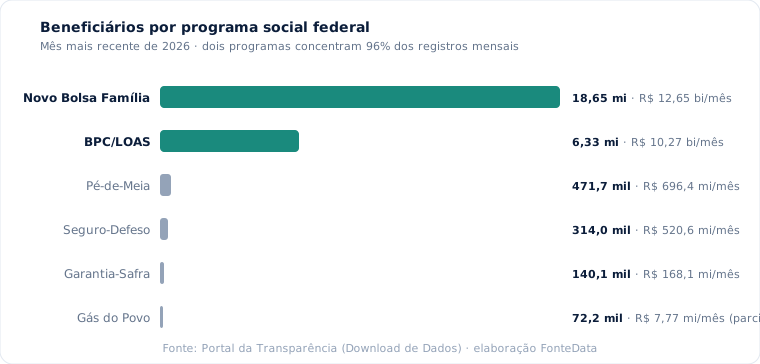
Two programs account for almost everything. Bolsa Família alone covers 18.65 million families and R$ 12.6 billion per month — about R$ 152 billion per year. BPC/LOAS adds another R$ 10.3 billion monthly. The remaining four programs, combined, don't reach R$ 1.4 billion in the month — but, as we'll see, some of them are far bigger than that "most recent month" suggests.
The giant, and the story of the year: Bolsa Família shrank
Comparing the same month (April) year over year strips out seasonal noise. And that's where the most significant movement of 2026 shows up: Bolsa Família lost beneficiaries.
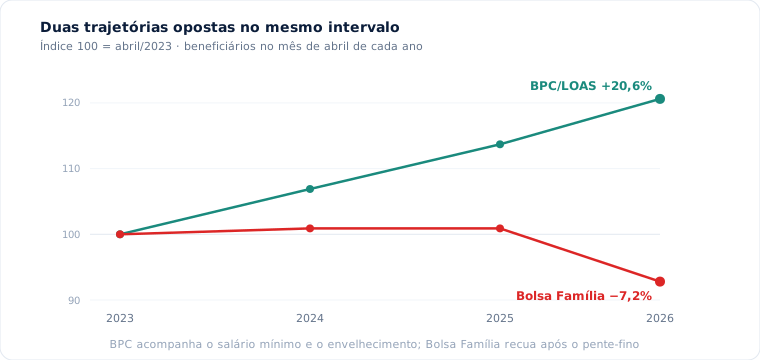
Between April 2023 and April 2026, the number of families fell -7.2% (from 20,091,550 to 18,654,273), with the drop concentrated in the 2025→2026 window. At the same time, the average payment rose +5.3% — fewer families, larger average benefit.
Because Bolsa Família is keyed by full NIS, you can track the same family across monthly snapshots and measure inflow and outflow — not just the net balance. And the gross flow tells a story the net number hides. In the 2025→2026 window, 3,470,784 families left (17.1%) while only 1,842,260 entered (9.9%) — a net balance of roughly -1.6 million. It wasn't just people leaving: it was people leaving while the entry door was jammed.
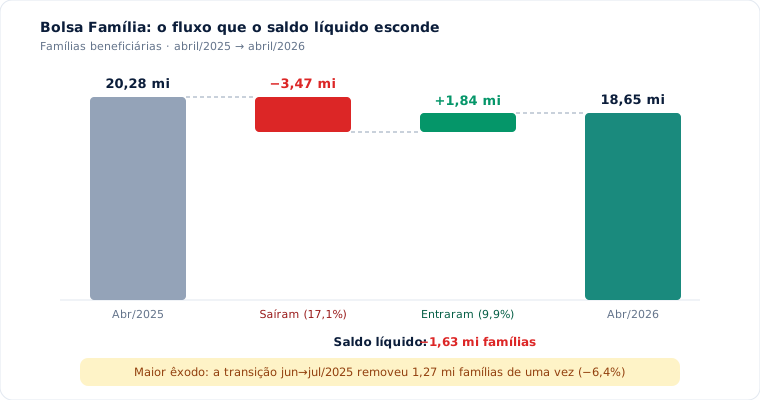
Decomposing month by month, the exodus has a date and a size: the June→July 2025 transition removed 1,272,761 families at once (6.4%) — the largest jump in the series, with all the hallmarks of a mass administrative cancellation (a registry audit), not a diffuse drift out of the program.
It's worth testing this against the official "graduating by income" narrative. Since the Portal does not publish income, we built a proxy: the Regra de Proteção (the program's "Protection Rule") pays ~50% of the benefit to families whose income rose, so a "~50% step-down" in payment value would be the signature of a family on its way out via income. Stacking all monthly transitions, families showing that step-down left at 2.7% the following month, versus 2.2% for stable families. A small difference — the proxy is weak, and that in itself is informative: what actually drained the stock was the batch cutoff, not a slow drip of income-driven exits.
Cohort survival, to close the loop: of the April 2023 "vintage" of families, 68.1% were still receiving after 36 months — meaning about a third of the original cohort left the program within three years.
The contrast: BPC/LOAS in structural expansion
While Bolsa Família shrinks, BPC/LOAS is growing structurally. Over the same April 2023→April 2026 window, beneficiaries rose +20.6% (from 5,251,094 to 6,331,525) and the average payment +24.5% — the latter tracking the minimum wage, since BPC pays exactly one minimum wage (R$ 1,621 in 2026). The combined effect pushed program spending up by about 50% over the period. It's the demographic vector (an aging population) compounded by increases to the wage floor. Two stable, monthly programs telling opposite stories over the same interval.
The traps waiting for anyone who processes this data
Here's the part that separates a correct analysis from a wrong one. If you're going to consume the Portal da Transparência in production, watch out for four things.
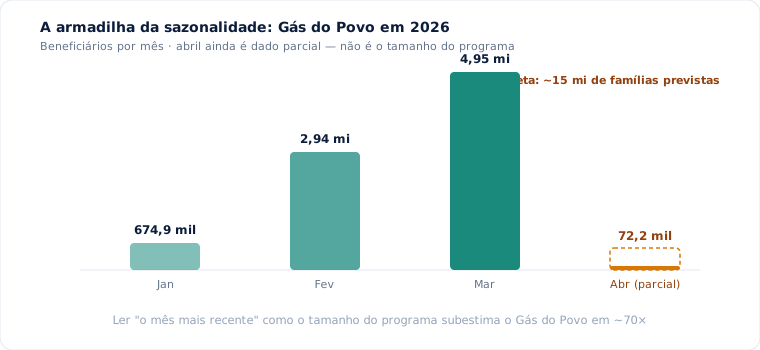
1. Seasonality — don't read "the most recent month" as if it were the program. In the table above, Gás do Povo shows 72 thousand beneficiaries in April 2026. It looks like a tiny program. It isn't: it was in an enrollment ramp-up and went 674.9 thousand (Jan) → 2.94 million (Feb) → 4.95 million (Mar), on its way to the ~15 million families planned. April drops to 72 thousand because the month's data is partial. The same applies to Garantia-Safra, which pays in batches: March 2026 had 682 thousand beneficiaries versus 140 thousand in April. The April-over-April "drop" is a calendar artifact. Seasonal programs (Seguro-Defeso and Pé-de-Meia too) require you to understand the payment window before comparing periods.
2. NIS vs. masked CPF — the key is not uniform. Identifier coverage varies wildly by program:
| Program | % NIS | % CPF | % no key |
|---|---|---|---|
| Novo Bolsa Família | 100.0 | 0.0 | 0.0 |
| Garantia-Safra | 100.0 | 0.0 | 0.0 |
| Seguro-Defeso | 100.0 | 0.0 | 0.0 |
| BPC/LOAS | 87.7 | 0.0 | 12.3 |
| Pé-de-Meia | 15.2 | 0.0 | 84.8 |
| Gás do Povo | 0.0 | 99.9 | 0.1 |
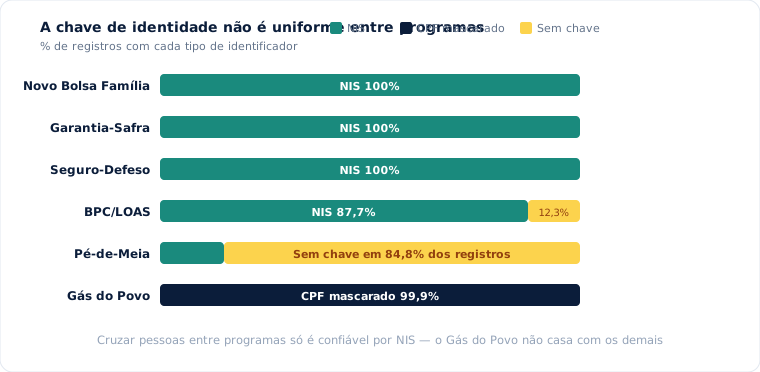
Note: Pé-de-Meia has NIS in only 15% of its records, and Gás do Povo uses no NIS at all — only masked CPFs. Any person-level match across programs has to handle this explicitly.
3. Exits are always inferred, never reported. The Portal publishes monthly snapshots, not events. You infer entries and exits by diffing consecutive snapshots — and that's only reliable where the key is stable (full NIS). Where the key is weak, "exit" and "entry" turn into noise.
4. Key-collision risk in cross-program matching. Matching programs by NIS is reliable. Matching against the slice that only has a masked CPF (Gás do Povo) is approximate and doesn't join against NIS keys — any "people in N programs" figure that includes Gás do Povo is an estimate, not a measurement.
Regional and payment-bracket distribution
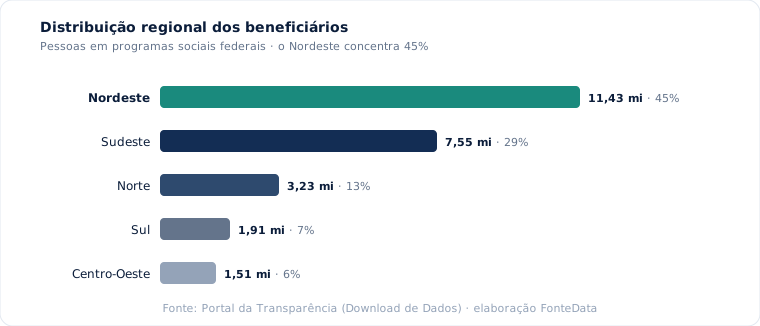
The geographic concentration is stark: the Northeast accounts for ~45% of beneficiaries, with 11.4 million people and R$ 10.4 billion. It's followed by the Southeast (7.55 mn), North (3.23 mn), South (1.91 mn) and Center-West (1.51 mn).
| Region | Beneficiaries | Total amount |
|---|---|---|
| Northeast | 11,434,784 | R$ 10.43 bn |
| Southeast | 7,552,532 | R$ 7.33 bn |
| North | 3,231,553 | R$ 3.06 bn |
| South | 1,910,830 | R$ 1.93 bn |
| Center-West | 1,512,138 | R$ 1.55 bn |
By payment bracket, Bolsa Família is homogeneous: about 83% of families receive between R$ 600 and R$ 1,000 per month (15.58 million of the 18.65 million). Predictable payments, tight distribution — the opposite of BPC, where virtually everyone receives exactly one minimum wage.
Cross-program overlap (an estimate)
Combining the datasets on the NIS key (and treating Gás do Povo as an approximation), the overwhelming majority of people are in a single program: ~24.43 million. About 342.8 thousand people appear in two programs and only 533 in three. The most common combinations are Bolsa Família + Seguro-Defeso (145.7 thousand), Bolsa Família + Pé-de-Meia (65.7 thousand) and Garantia-Safra + Bolsa Família (64.1 thousand) — overlaps that make sense given the regional and socioeconomic profile of each population. To reiterate: everything here is an estimate, bounded by key quality outside Bolsa Família.
How to access and enrich this data programmatically
The Portal da Transparência files are open and can be downloaded directly from the Download de Dados section — as CSV, per program and per month. For a production pipeline, the real work isn't downloading: it's normalizing the key, handling the seasonality and resolving identity.
And it's on that identity point that these datasets hit a wall: Bolsa Família doesn't publish CPFs, Gás do Povo only publishes masked CPFs, and none of them include registration status, a validated full name or corporate ties. If your use case needs to resolve or validate the identity behind these records — KYC, due diligence, deduplication, compliance with Resolução BCB nº 457/2025 (the Central Bank rule mandating Pix key validation) — you'll need a CPF and CNPJ (Brazilian company registration number) lookup layer.
That is exactly what FonteData delivers via REST API: CPF and CNPJ lookups with registration status from the Receita Federal (Brazil's federal tax authority), 100+ data sources, sub-200 ms responses and an instant API key. A lookup is a single request:
cURL:
curl -H "X-API-Key: fd_live_sua_chave_aqui" \
  "https://app.fontedata.com/api/v1/consulta/cadastro-rf-pf?cpf=12345678900"
Python:
import requests

response = requests.get(
    "https://app.fontedata.com/api/v1/consulta/cadastro-rf-pf",
    params={"cpf": "12345678900"},
    headers={"X-API-Key": "fd_live_sua_chave_aqui"},
)

dados = response.json()
receita = dados["receita"]

if receita["situacaoCadastral"] == "REGULAR":
    print(f"CPF regular — titular: {receita['nomePessoaFisica']}")
else:
    print(f"CPF com situação: {receita['situacaoCadastral']}")
Node.js:
const response = await fetch(
  "https://app.fontedata.com/api/v1/consulta/cadastro-rf-pf?cpf=12345678900",
  { headers: { "X-API-Key": "fd_live_sua_chave_aqui" } }
);

const { receita } = await response.json();
console.log(receita.situacaoCadastral, receita.nomePessoaFisica);
You can start with R$ 50 in free credits, no credit card required — create your account and test the integration in minutes. The documentation covers every endpoint.
Frequently asked questions
Is Brazil's federal social benefits data public? Yes. The Portal da Transparência publishes, monthly and in open format, the payments of programs such as Bolsa Família, BPC/LOAS, Gás do Povo, Garantia-Safra, Seguro-Defeso and Pé-de-Meia, in its Download de Dados section. It is open data, free to query and reuse.
Does Bolsa Família publish beneficiaries' CPFs? No. Bolsa Família identifies each family only by its full NIS (the CadÚnico number). To obtain or validate the associated CPF, you need a separate identity source.
Why did the number of Bolsa Família beneficiaries fall in 2026? The data shows a -7.2% drop between April 2023 and April 2026, with a concentrated exodus of 1.27 million families in July 2025 — a pattern consistent with a registry audit (a mass eligibility sweep) combined with a jammed entry pipeline, rather than exits driven by rising income.
How do you match people across different social programs? Reliable matching is done via NIS, present in 100% of Bolsa Família, Garantia-Safra and Seguro-Defeso records. BPC/LOAS has 87.7% coverage, and Gás do Povo uses only masked CPFs — so any match involving that program is an estimate.
Further reading
- Brazil CPF Lookup API (2026) — Tutorial with Code Examples
- Brazil CNPJ Lookup API (2026): The Complete Guide
- Brazil's New Pix Rules for 2026: Mandatory CPF and CNPJ Validation with the Receita Federal
Analysis produced by FonteData from public Portal da Transparência data (Download de Dados), monthly series 202601–202604 and April year-over-year control, 2023–2026. Data provided by FonteData is obtained from official Brazilian government public sources and/or from third-party providers that declare exclusive use of public sources, in compliance with the LGPD (Brazil's data protection law, Lei nº 13.709/2018).
Try the FonteData API
Query Brazilian company and individual data via API — CNPJ, CPF, KYC, compliance and more. R$50 in free credits to test.
Create free account →